
Exhumation in Madagascar? Famadihana and the Enduring Bond Between the Living and the Ancestors?
- Dec 27, 2025
- 5 min read
Updated: Jan 26
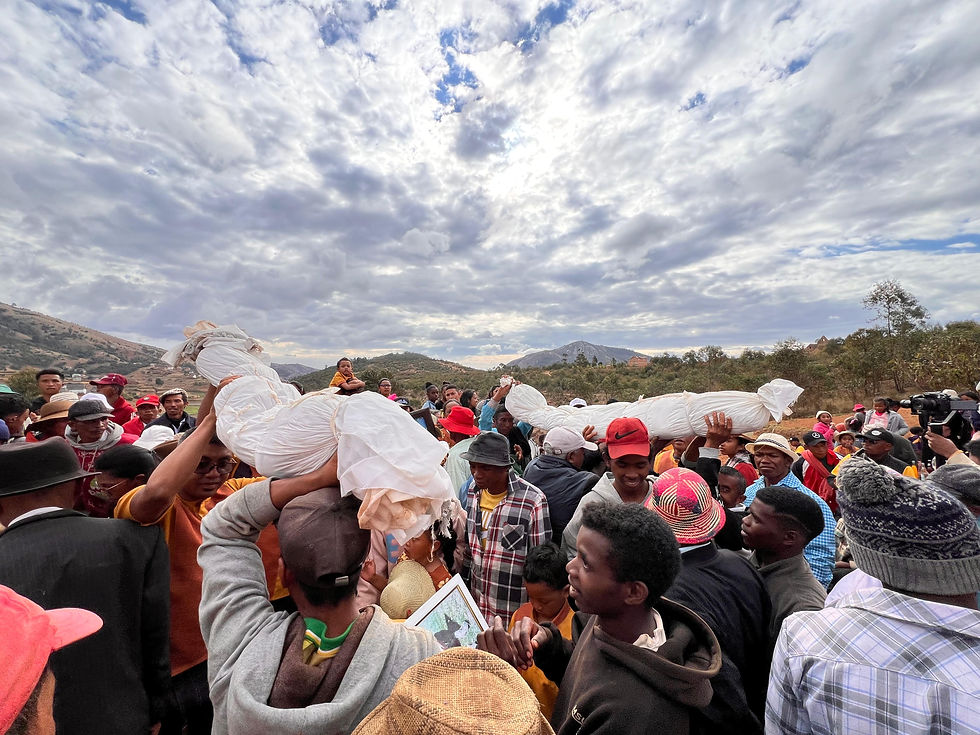
The Ultimate Guide to Exhumation in Madagascar (Famadihana) is a comprehensive, in-depth resource designed to explain everything you need to know about this unique ancestral tradition.
From the Malagasy worldview of life and death to the historical origins, ritual practices, symbolism, and modern challenges of Famadihana, this guide offers a complete and respectful understanding of exhumation in Madagascar. Ideal for readers seeking cultural, historical, and spiritual insight, this article serves as the definitive reference on Famadihana and its enduring importance in Malagasy society.
Madagascar, the world’s fourth-largest island, is home to an extraordinary mosaic of cultures, languages, and belief systems. Among its most profound and enduring traditions is exhumation, known locally as Famadihana, or “the turning of the bones.” This ancestral ceremony, practiced for centuries, reflects a worldview in which death is not an ending, but a transformation : one that strengthens the relationship between the living and those who came before them.
To outsiders, the idea of exhuming ancestors may seem unusual or even unsettling. In Malagasy culture, however, Famadihana is an act of love, honor, celebration, and continuity. It is a ritual deeply embedded in identity, spirituality, family structure, and social cohesion.
This article offers a comprehensive exploration of exhumation in Madagascar : its origins, meanings, rituals, variations, challenges, and relevance in the modern world.
Introduction
To fully understand the tradition of Famadihana, it is essential to explore the cultural, spiritual, and social foundations that shape Malagasy views of life, death, and ancestry. This section examines the Malagasy worldview, the historical roots of exhumation, and the communities that continue to practice it today. It also explores the sacred role of ancestral tombs, the careful preparation behind Famadihana, the ritual itself, and its enduring symbolism. Together, these elements reveal why exhumation in Madagascar remains a powerful expression of identity, continuity, and respect for ancestors in both traditional and modern contexts.
The Malagasy Worldview: Life, Death, and the Ancestors
Historical Origins of Famadihana and Who Practices Exhumation in Madagascar?
The Famadihana Ceremony in Detail
The Malagasy Worldview: Life, Death, and the Ancestors
To understand Famadihana, one must first understand the Malagasy perception of life and death.
In traditional Malagasy belief, ancestors (razana) are not distant memories. They are active spiritual forces who influence daily life, health, fertility, success, and harmony. Respecting ancestors ensures balance between the visible world (tontolo hita maso) and the invisible spiritual world (tontolo tsy hita maso).
Death is seen as a gradual transition, not an immediate separation. The spirit of the deceased is believed to linger near the living until the body has fully decomposed. Only then can the ancestor fully join the spiritual realm and act as a protector for descendants.
Famadihana plays a crucial role in this transition.

Historical Origins of Famadihana and Who Practices Exhumation in Madagascar?
The precise origins of Famadihana are difficult to trace, as Malagasy history was traditionally transmitted orally. However, historians and anthropologists believe the ritual predates European contact and evolved alongside Madagascar’s complex mix of African, Austronesian, and Arab influences.
Royal Merina society practiced elaborate funerary rites, emphasizing the importance of tombs and ancestral land. Over time, these practices spread and adapted among various highland communities, becoming a defining feature of Malagasy cultural identity.
Famadihana was never merely a funeral practice ; it became a social institution, reinforcing lineage, inheritance, and collective responsibility.
Who Practices Exhumation in Madagascar?
Famadihana is most commonly practiced among:
Merina (central highlands)
Betsileo (southern highlands)
Other ethnic groups may have similar or related rituals, though not all Malagasy communities practice exhumation. Coastal groups, for example, often have different funerary traditions emphasizing immediate burial and spiritual release.
Even among those who practice Famadihana, customs vary by region, family lineage, and local beliefs.
The Ancestral Tomb: A Sacred Space
Ancestral tombs (fasana) are among the most sacred structures in Malagasy culture. Often built of stone or concrete and passed down through generations, these tombs represent:
Family unity
Ancestral authority
Territorial belonging
The orientation, location, and construction of a tomb are carefully chosen according to tradition and astrology. Many tombs are located on ancestral land, reinforcing the spiritual bond between people, place, and lineage.
Opening a tomb is a solemn act that requires ritual approval and spiritual preparation.
Planning Famadihana: A Collective Responsibility

Famadihana is not a spontaneous event. Planning can
take years.
Spiritual Preparation
Families consult mpanandro (traditional astrologers)
to determine an auspicious date. Dreams, omens,
and ancestral signs often influence the decision.
Financial Preparation
The ceremony can be expensive. Costs include:
Silk burial shrouds (lamba mena)
Food and drink for guests
Musicians and dancers
Travel expenses for relatives
Ritual offerings
Despite the cost, families consider the expense a sacred duty. Cutting corners may be seen as disrespectful to the ancestors.
The Famadihana Ceremony in Detail
3.1. Gathering of the Family
Extended families gather, sometimes reuniting relatives who have not seen each other for years. These reunions strengthen kinship bonds and reinforce family history.
3.2. Opening the Tomb
The tomb is ceremonially opened with prayers, offerings, and traditional music. Elders lead the ritual, asking ancestors for permission and blessings.
3.3. Exhumation of the Ancestors
The remains are gently removed, treated with care and reverence. Each ancestor is acknowledged by name, reinforcing remembrance and identity.
3.4. Rewrapping in Fresh Silk
The old burial cloth is replaced with new lamba mena. Silk represents purity, honor, and renewal. Families often whisper messages to their ancestors ; sharing news, gratitude, or requests for guidance.
3.5. Dance and Celebration
This is the most visually striking part of Famadihana. Families dance with the wrapped remains, accompanied by live music, laughter, and joy. The celebration expresses the belief that ancestors share in the happiness of the living.
3.6. Feast and Storytelling
Large communal meals follow. Elders recount family history, teaching younger generations about their lineage and responsibilities.
3.7. Returning the Ancestors
The ancestors are carefully returned to the tomb, now renewed and honored. The tomb is sealed, and final blessings are offered.
Symbolism Within the Ritual
Every element of Famadihana carries symbolic meaning:
Silk shrouds – renewal, respect, continuity
Music and dance – joy, life, unity
Feasting – abundance and shared responsibility
Tomb reopening – connection between worlds
The ritual emphasizes that ancestors are not feared but cherished.
Famadihana in Modern Madagascar
Religion and Tradition
Christianity is widespread in Madagascar, yet many Christian families continue Famadihana, viewing it as cultural rather than religious. Others choose not to practice it, illustrating the diversity of modern Malagasy identity.
Urbanization and Migration
As more Malagasy people move to cities or abroad, organizing Famadihana becomes more challenging. Still, many return home specifically for these ceremonies, reaffirming ancestral ties.
Public Health and Law
During disease outbreaks, particularly plague, authorities have discouraged exhumations for safety reasons. This has sparked debates between tradition and modern public health concerns.
Ethical and Cultural Sensitivity
Famadihana is not a spectacle. While it has attracted international attention, it remains a private, family-centered ritual. Photographing or attending without consent is considered disrespectful.
Understanding Famadihana requires cultural humility and recognition of its sacred nature.
Why Famadihana Endures
Despite modernization, Famadihana remains deeply meaningful because it addresses universal human needs:
Remembering loved ones
Maintaining identity
Honoring origins
Creating continuity across generations
In Malagasy culture, forgetting ancestors is equivalent to losing oneself.
Conclusion: Exhumation as an Expression of Life
Exhumation in Madagascar is not about death, it is about relationship. Famadihana expresses gratitude, remembrance, and responsibility toward those who shaped the present.
In a rapidly changing world, this tradition continues to anchor Malagasy people to their past while guiding them into the future. It stands as a powerful reminder that culture is not static : it lives, breathes, and dances across generations.


Comments